


Are you a new member? Sign up now
Login area
| Sign up
Let us help you
Read about the latest topics.
Read about the latest topics.


Introduction:
The Baby Friendly Hospital Initiative (BFHI) is a global accreditation program launched in 1991 by the World health organization (WHO) and United Nations International Children's Emergency Fund (UNICEF).
In Lebanon, the BFHI is led by the Ministry of Public Health (MOPH), particularly the unit of Mother, Child and School health.
The BFHI is part of the National Infant and Young Child Feeding (IYCF) policy supported by UNICEF developed in March 2018.
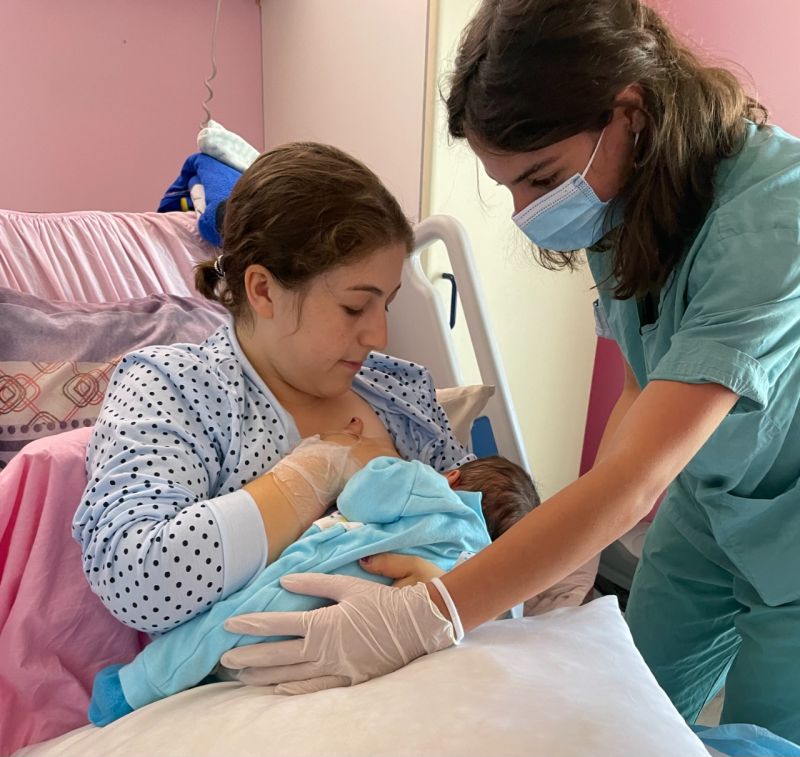
The BFHI goal is to improve healthcare for babies, their mothers and families in Lebanon. The BFHI enables health care services to better support mothers and families to ensure that all newborns and infants get the best possible start in life.
Mission:
The BFHI aims to protect, promote and support breastfeeding practices in healthcare facilities providing maternity and newborn services, while enabling timely and appropriate care and feeding of newborns who are not breastfed.
Objectives:
The Six main objectives of the BFHI are to:
- Enable mothers to make an informed choice about how to feed their newborns.
- Support early initiation of breastfeeding.
- Promote exclusive breastfeeding for the first 6 months of life, and introduce nutritionally-adequate and safe complementary (solid) foods at 6 months while continuing breastfeeding up to 2 years of age or beyond.
- End distribution of free and low-cost supplies of breast-milk substitutes to maternity wards and hospitals.
- Help reduce the levels of infant morbidity and mortality in Lebanon.
- Increase the breastfeeding rates in Lebanon.
Certification Process:
To become a designated Baby Friendly Hospital, hospitals must ensure compliance with the Lebanese law 47/2008 for “organizing the marketing of infant and young child feeding products and tools .
In addition, they should fulfill the requirements of the BFHI 10 steps that have been outlined by the WHO and UNICEF which were reviewed in 2018 and adapted by the Ministry of Public Health in Lebanon.
Appendix 1: Law 47/2008
Appendix 2: BFHI 10 steps
The baby friendly hospital (BFH) certification process includes several stages:
First stage:
To become a designated Baby Friendly Hospital, hospitals must ensure compliance with the Lebanese law 47/2008 for “organizing the marketing of infant and young child feeding products and tools .
In addition, they should fulfill the requirements of the BFHI 10 steps that have been outlined by the WHO and UNICEF which were reviewed in 2018 and adapted by the Ministry of Public Health in Lebanon.
Appendix 1: Law 47/2008
Appendix 2: BFHI 10 steps
The baby friendly hospital (BFH) certification process includes several stages:
First stage:
- Registration:
The CEO of the hospital working towards baby friendly certification has to fill the BFHI registration form and send it to the unit of Mother, Child and School health at the MOPH via the following e-mail: motherchild@moph.gov.lb
Appendix 3: BFHI registration form
Appendix 3: BFHI registration form
- Self-appraisal process:
The hospital undergoes self-appraisal using the WHO self-appraisal tool.
This tool is used to evaluate the hospital’s current application and practices of the ten steps to successful breastfeeding. This in turn will help in developing an action plan based on the results of the latter evaluation.
Appendix 4: WHO self-appraisal tool
- Orientation visit:
Once the self-appraisal process is completed, an orientation visit to the candidate hospital is performed by the BFHI monitoring team to address the 10 steps criteria requiring additional work for the hospital to become baby friendly.
- Application of commitment:
The CEO of the hospital or an equivalent hospital staff will fill and sign an application of commitment if the candidate hospital has fulfilled the following requirements:
- Forming a multidisciplinary breastfeeding committee
- Assigning a breastfeeding coordinator.
- Developing a breastfeeding policy that covers all the BFHI steps ( Hospital policy checklist and National Policy sample).
- Developing the procedures needed for the BFHI 10 steps program.
- Developing a BFHI work plan to ensure the implementation of 10 steps and the law 47/2008.
- Developing a training plan for the clinical and non-clinical staff.
- Developing a prenatal, perinatal and postnatal education plan.
- Developing a data collection plan for documentation, auditing and evaluation of standards.
All developed policies, plans and educational materials will be reviewed and approved by The BFHI monitoring team.
Appendix 5: Application of commitment
Appendix 6: WHO policy checklist
Appendix 7: National Policy sample
Second stage:
Appendix 5: Application of commitment
Appendix 6: WHO policy checklist
Appendix 7: National Policy sample
Second stage:
- Implementation stage:
During this stage the hospital should:
- Train the clinical staff providing clinical care for pregnant women, mothers and their babies, in addition to training the non-clinical staff providing non-clinical care for pregnant women, mothers and their babies or having contact with them in some aspect of their work.
- Implement the hospital’s BFHI policy, action plans, and law 47/2008.
- Collect pertinent data relevant to the 10 steps. Follow up evaluation visits and technical support will be provided by the BFHI monitoring team during the implementation phase.
- Certification:
Request for external assessment:
Once the evaluation report is completed by the BFHI monitoring team, the CEO of the hospital or an equivalent hospital staff should report to the MOPH (Mother, Child and School health unit) via the following email: motherchild@moph.gov.lb requesting an external assessment.
To note: The report of the national BFHI monitoring team should document the accomplishment of all steps and the hospital documentation and internal audits should be consistent with this report, to facilitate the external auditing process.
External assessment:
The external assessment is a two-step process:
- A verification of the hospital’s policies, educational material, action plans, staff training, and competency verification.
- On-site interviews with the staff and patients.
The assessment will be conducted by a certified BFHI assessor, assigned by the IYCF National Committee.
Upon successful completion of the required 10 steps by the candidate hospital as reported by the certified BFHI assessor, the hospital will be granted the BFHI certification for 5 years by the MOPH (Mother, Child and School health unit).
Upon successful completion of the required 10 steps by the candidate hospital as reported by the certified BFHI assessor, the hospital will be granted the BFHI certification for 5 years by the MOPH (Mother, Child and School health unit).
- Recertification:
A redesignation process requires the facility to follow the same steps
Appendixes:
Appendix 1: Law 4 /2008
Appendix 2: BFHI 10 steps
Appendix 3: BFHI registration form
Appendix 4: WHO self-appraisal tool
Appendix 5: Application of commitment
Appendix 6: WHO policy checklist
Appendix 7: National Policy sample
Appendix 8: Baby Hospital Initiative Implementation Guidance -2018
Appendixes:
Appendix 1: Law 4 /2008
Appendix 2: BFHI 10 steps
Appendix 3: BFHI registration form
Appendix 4: WHO self-appraisal tool
Appendix 5: Application of commitment
Appendix 6: WHO policy checklist
Appendix 7: National Policy sample
Appendix 8: Baby Hospital Initiative Implementation Guidance -2018

Sitemap 
© Copyrights reserved to Ministry of Public Health 2026